



Patient engagement is no longer a “nice-to-have”, it is a core driver of both clinical and operational outcomes.
Healthcare organizations that actively engage patients tend to see:
- Higher treatment adherence;
- Better patient outcomes;
- Improved operational efficiency.
At the same time, the model of care delivery is shifting. Traditional, reactive approaches are being replaced by proactive, patient-centered engagement, where communication, access, and follow-up are continuous rather than episodic.
Patient expectations are also evolving. Today’s patients expect:
- Easy digital access to care;
- Real-time communication with providers;
- Personalized care journeys tailored to their needs and context.
However, most healthcare systems are not designed to support this level of engagement.
Common challenges include:
- Fragmented systems that don’t share data;
- Slow access to care and delayed responses;
- Disconnected communication across channels and departments.
These gaps create friction at every stage of the patient journey: from initial inquiry to follow-up care.
So, how to improve patient engagement in healthcare in a way that actually improves both patient outcomes and operational efficiency?
Key Takeaways
- Patient engagement directly impacts outcomes, adherence, and satisfaction;
- Access and communication are the foundation of engagement;
- Fragmented systems are the biggest barrier;
- AI and automation are transforming patient interaction models;
- Engagement must be designed as a system – not isolated initiatives.
What Is Patient Engagement (and Why It Matters)

Patient engagement refers to the active participation of patients in their own care.
Rather than being passive recipients of treatment, engaged patients are involved in decisions, communication, and follow-up processes throughout their healthcare journey.
This includes:
- Ongoing communication with care teams;
- Participation in decision-making;
- Adherence to treatment plans;
- Engagement in follow-up and preventive care.
The shift toward engagement represents a broader change in how healthcare is delivered – from provider-centered to patient-centered models.
Patient Engagement vs Traditional Care
| Aspect | Traditional Care | Patient Engagement |
| Role of patient | Passive | Active participant |
| Communication | One-way | Two-way |
| Focus | Treatment | Outcomes |
| Interaction | Episodic | Continuous |
In traditional models, interaction is often limited to appointments and treatment events. In contrast, patient engagement emphasizes continuous interaction: before, during, and after care delivery.
Why It Matters
Stronger patient engagement is consistently associated with better outcomes across both clinical and operational metrics:
- Better health outcomes. Patients who are actively involved in their care are more likely to follow treatment plans and make informed decisions.
- Higher adherence. Clear communication and ongoing engagement improve medication adherence and follow-up compliance.
- Lower readmissions. Continuous engagement helps identify issues earlier and reduces avoidable hospital returns.
- Improved patient satisfaction. Patients who feel informed and supported are more satisfied with their care experience.
In practice, patient engagement is not just about communication – it is about building a continuous, coordinated relationship between patients and healthcare providers.
Why Patient Engagement Is Still a Challenge
Despite its importance, patient engagement remains difficult to implement at scale.
The issue is rarely a lack of awareness. Most healthcare organizations recognize the value of engagement but struggle with execution.
Several structural challenges continue to limit progress:
- Limited access to care. Patients often face delays in scheduling, long wait times, or difficulty reaching the right provider. This creates friction at the very first step of engagement.
- Long response times. Many organizations still rely heavily on phone-based systems and manual processes, leading to slow responses and missed opportunities to engage patients in real time.
- Fragmented communication channels. Patient interactions are often spread across calls, emails, portals, and in-person visits, without a unified view or consistent context.
- Administrative overload. Care teams spend a significant amount of time on scheduling, coordination, and documentation, reducing their capacity for meaningful patient interaction.
- Lack of personalization. Without centralized data and integrated systems, communication remains generic rather than tailored to individual patient needs.
Most healthcare organizations don’t lack intent, they lack systems capable of supporting consistent, scalable patient engagement.
Top 8 Strategies to Improve Patient Engagement
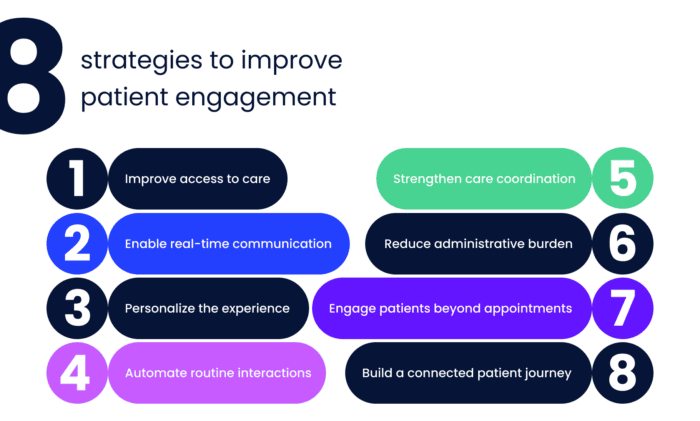
Improving patient engagement is not about adding more communication channels, it’s about removing friction across the entire patient journey.
The following strategies focus on the areas that have the greatest impact on both patient outcomes and operational efficiency.
1. Improve Patient Access to Care
Access is the foundation of patient engagement. If patients struggle to reach providers, schedule appointments, or get answers, engagement breaks down before it even begins.
Key priorities include:
- Simplifying appointment booking;
- Reducing wait times;
- Offering digital entry points such as chat, web, and mobile.
In many organizations, access is still limited by manual processes, phone-based systems, and fragmented scheduling workflows.
Omnito for Patient Engagement
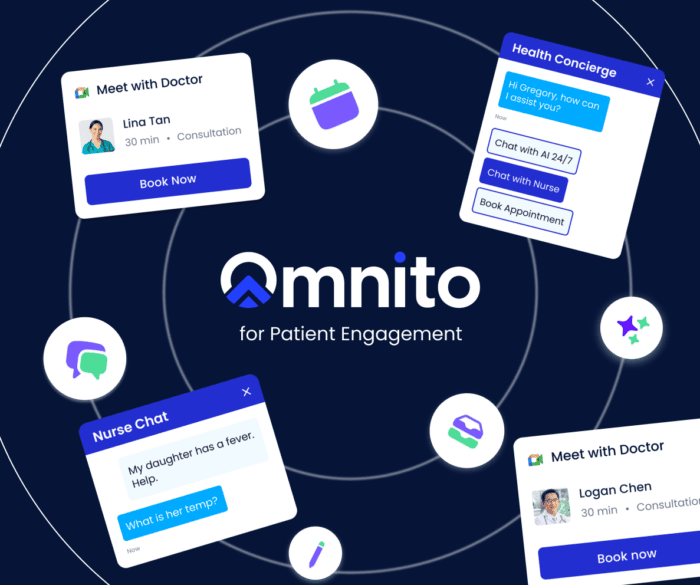
Platforms like Omnito address this by connecting inquiry, intake, scheduling, and follow-up into a single flow, so patients can self-schedule, get routed to the right provider, and communicate across chat, email, or SMS without friction or back-and-forth. The result is faster access and less administrative load on care teams.
This approach has a measurable impact in practice. Medtronic, an Omnito customer, replaced manual coordination with automated self-scheduling and intelligent routing – increasing first-time appointments by over 15% and eliminating double booking and scheduling conflicts entirely, while significantly reducing the administrative burden on care teams.
Patient engagement starts with access – and access starts with removing friction.
2. Enable Real-Time Patient Communication
Traditional healthcare communication is often slow and asynchronous, relying heavily on phone calls and delayed responses. This creates friction at exactly the moment patients need support, and friction leads to disengagement.
Modern patient engagement requires real-time interaction across the channels patients already use: chat, SMS, and mobile. The goal is to reduce reliance on call centers and enable faster, more convenient communication that answers questions immediately, reduces uncertainty, and increases the likelihood of follow-through on care.
AI-powered chat is increasingly central to this shift. Tools like Omnito Live Chat let patients start with AI that’s trained on your organization’s information, answering common questions, checking provider availability, and booking appointments directly within the conversation, with seamless handoff to a live staff member when the situation requires it. Patients get faster answers; care teams spend less time on routine inquiries.
3. Personalize the Patient Experience
Patients expect communication that reflects their specific needs, conditions, and history.
Generic messaging reduces engagement and can lead to confusion or disengagement.
Personalization can include:
- Tailored appointment reminders;
- Condition-specific education;
- Context-aware communication based on previous interactions.
Effective personalization requires integrated data across systems; without it, engagement remains superficial.
4. Use AI to Automate Routine Interactions
A large portion of patient communication is repetitive and predictable: appointment confirmations, intake questions, FAQ responses, and basic triage. Handling these manually consumes staff time that could be spent on more complex, higher-value interactions.
AI can manage these touchpoints efficiently and consistently: answering common questions instantly, collecting intake information before appointments, and classifying requests so they reach the right person faster.
The result is a better experience for patients and a meaningfully lighter workload for care teams.
5. Strengthen Care Coordination
Patient engagement is not limited to individual interactions, it depends on how well care is coordinated across teams.
Disconnection between departments leads to:
- Repeated information requests;
- Delays in care;
- Frustration for patients.
Improving coordination means connecting systems across departments, sharing patient context in real time, and ensuring continuity across the full care journey. When a patient moves from inquiry to intake to appointment to follow-up, the experience should feel like one conversation, not four separate ones.
6. Reduce Administrative Burden for Staff

Administrative work is one of the biggest barriers to effective patient engagement.
When staff spend most of their time on scheduling, documentation, and coordination, less time is available for patient interaction.
Key areas to address include scheduling workflows, note-taking, and follow-up coordination. Automation can significantly reduce this burden, tools like Omnito automatically capture visit summaries, action items, and follow-up tasks, while supporting encrypted communication, role-based access, and HIPAA-aligned security controls. Care teams spend less time on paperwork and more time with patients.
7. Engage Patients Beyond Appointments
For most healthcare organizations, engagement effectively ends when the appointment does. But the period between visits is often where adherence breaks down, complications develop, and patients disengage from their care plan.
Ongoing interaction is critical for:
- Improving adherence;
- Supporting recovery;
- Preventing complications.
This includes:
- Follow-up messages after visits;
- Appointment reminders;
- Continuous communication between care episodes.
Organizations that maintain engagement between visits typically see better long-term outcomes.
8. Build a Connected Patient Journey
Individual strategies only go so far. The organizations that see the greatest improvement in patient engagement are those that connect every stage of the journey – inquiry, intake, routing, appointment, and follow-up – into a single, coherent experience.
Each step should be connected, context-aware, and frictionless. When these elements work together, engagement stops being something care teams have to manage manually and becomes something the system delivers by design.
Patient engagement improves not through individual tactics, but through connected systems that remove friction at every stage of the patient journey.
Patient Engagement Tools & Platforms
Patient engagement is often approached through individual tools: scheduling systems, messaging platforms, or EHRs. However, these tools typically solve isolated problems rather than the full patient journey.
To deliver consistent and scalable engagement, healthcare organizations need to understand how different tool categories work together.
Core Types of Patient Engagement Tools
| Tool Type | Role |
| Scheduling systems | Enable access to care (appointments, availability) |
| Communication tools | Support interaction (chat, SMS, portals) |
| EHR / CRM systems | Store and manage patient data |
| Engagement platforms | Orchestrate the entire patient journey |
Each category plays an important role, but on its own, it is not sufficient.
- Scheduling systems provide access but lack context;
- Communication tools enable interaction but are often disconnected;
- EHRs store data but are not designed for real-time engagement.
This is where engagement platforms become critical.
They act as a coordination layer – connecting access, communication, and data into a single system that supports continuous patient interaction. A platform approach enables unified patient communication across channels, context-aware interactions based on data, and seamless transitions between inquiry, scheduling, and follow-up.
Omnito’s patient engagement platform is built on this model, connecting live chat, intelligent scheduling, omni-channel inbox, and automated follow-ups into one system, so care teams have full context at every stage of the patient journey. In practice, this means patients are no longer moving between disconnected systems – the system adapts to them.
The Role of AI and LLMs in Patient Engagement
Artificial intelligence is becoming a central component of modern patient engagement strategies.
Rather than relying on manual processes and reactive communication, healthcare organizations are moving toward proactive, automated interaction models.
What’s Changing
- Reactive care → proactive engagement;
- Manual workflows → automated processes.
Instead of waiting for patients to reach out, systems can now initiate communication, guide interactions, and support decision-making in real time.
Key Capabilities
AI and LLM-driven systems enable several high-impact use cases:
- AI chat for patients – Answer common questions, guide patients through next steps, and provide immediate support without requiring staff intervention.
- Predictive engagement – Identify when patients are likely to need care, follow-ups, or reminders – and act proactively.
- Automated follow-ups – Send reminders, post-visit instructions, and check-ins without manual coordination.
These capabilities help reduce delays, improve adherence, and create a more responsive patient experience.
Important Nuance
AI is not a standalone solution – especially in healthcare.
To be effective, it must be:
- Secure – protecting sensitive patient data;
- Compliant (e.g., HIPAA-aligned) – meeting regulatory requirements;
- Integrated – connected to existing systems such as EHRs, scheduling, and communication tools.
Omnito is built with this in mind, supporting encrypted communication, role-based access, and HIPAA-aligned security controls across scheduling, messaging, and patient data.
Common Mistakes in Patient Engagement
Even with the right tools and intent, many healthcare organizations struggle to improve patient engagement due to structural missteps.
- Treating engagement as communication only – Engagement is often reduced to messaging or outreach, while underlying issues like access and coordination remain unresolved.
- Ignoring access issues – If patients cannot easily schedule or reach care, no amount of communication will improve engagement. Access is the foundation.
- Overloading staff with manual processes – Relying on manual scheduling, follow-ups, and coordination reduces efficiency and limits the ability to scale engagement.
- Fragmented systems – Disconnected tools create inconsistent experiences and prevent a unified view of the patient journey.
- Lack of follow-up strategy – Engagement often ends after the appointment, missing opportunities to improve adherence and long-term outcomes.
Patient engagement fails not because of lack of effort, but because of disconnected systems and incomplete strategies.
Patient Engagement vs Patient Experience
Patient engagement and patient experience are closely related but they are not the same.
Many healthcare organizations focus heavily on experience (satisfaction, comfort, perception), while underinvesting in engagement (interaction, access, continuity).
Key Differences
| Aspect | Patient Engagement | Patient Experience |
| Definition | Active interaction between patient and care system | Patient’s perception of care quality |
| Focus | Actions and participation | Feelings and satisfaction |
| Scope | Communication, access, follow-ups, adherence | Environment, service quality, emotional response |
| Timing | Continuous (before, during, after care) | Often tied to specific encounters |
| Measurability | Behavioral metrics (adherence, follow-ups) | Survey-based metrics (satisfaction, NPS) |
Why the Distinction Matters
A patient may have a positive experience during a visit but still fail to follow treatment plans or miss follow-ups.
Conversely, strong engagement ensures that:
- Patients stay connected to care;
- Communication continues beyond appointments;
- Outcomes improve over time.
Experience reflects how patients feel about care. Engagement determines what patients actually do.
The most effective healthcare organizations focus on both but use engagement as the operational foundation.
Bottom Line
Patient engagement is evolving from isolated initiatives into system-driven processes.
Healthcare organizations are moving away from fragmented communication and manual workflows toward integrated, data-driven engagement models – and AI and automation are accelerating that shift.
But the biggest opportunity remains structural, not technological. Improving patient engagement ultimately depends on how well the patient journey is connected end to end. Disconnected systems create friction. Connected systems remove it.
The healthcare organizations that improve patient engagement are not those that communicate more – but those that remove friction across the entire patient journey.
FAQ
What is patient engagement in healthcare?
Patient engagement refers to the active involvement of patients in their own care, including communication with providers, participation in decisions, and adherence to treatment and follow-ups.
Why is patient engagement important?
It improves clinical outcomes, increases adherence to treatment plans, reduces readmissions, and enhances overall patient satisfaction.
How can hospitals improve patient engagement?
Hospitals can improve engagement by simplifying access to care, enabling real-time communication, personalizing interactions, and connecting the patient journey across systems and departments.
What tools improve patient engagement?
Effective patient engagement typically requires a combination of tools, including scheduling systems, communication platforms, EHR/CRM systems, and integrated engagement platforms that connect these elements. Omnito combines all of these into one connected system, covering chat, scheduling, messaging, and automated follow-ups for the full patient journey.
How does AI improve patient engagement?
AI improves engagement by automating routine interactions, enabling real-time responses, supporting personalized communication, and helping healthcare organizations proactively manage patient needs.
Ready to remove friction from your patient journey? Explore Omnito’s patient engagement platform: start for free or get a demo.
Start Free Trial
Create an Omnito account in seconds.
Get stated
- Saved to Salesforce
- Searchable in Einstein
- Smart notes & follow-ups
- Works with your calendar & tools
- No Agentforce needed

Recent Articles

 Google
 Microsoft




Hi, I'm Nito!
I'm here to help. Who should I connect you with?