



Customer engagement tools are no longer optional – they define how brands communicate, retain, and grow their customer base. What used to be a set of supporting systems has become a core part of revenue generation, directly influencing retention, repeat purchases, and customer lifetime value.
At the same time, the engagement landscape has fundamentally changed. Businesses are no longer operating in a single-channel environment. Customers move fluidly between websites, mobile apps, social media, and offline touchpoints, and they expect these interactions to feel connected, not fragmented.
This shift has led to the rise of the customer engagement platform – a more integrated approach that replaces isolated tools with unified systems capable of managing the entire customer journey.
Expectations have also increased. Modern customers expect:
- Real-time responses across channels;
- Personalized communication based on behavior and intent;
- Consistent experiences regardless of where the interaction starts or ends.
Despite this, many companies still rely on disconnected tools. Marketing, support, and product teams often operate in separate systems, leading to inconsistent messaging and broken customer journeys.
Fragmentation remains the biggest issue – not the lack of tools, but the lack of coordination between them.
So, which customer engagement tools actually deliver measurable business impact, not just features?
Key Takeaways
- Customer engagement tools directly impact retention, LTV, and conversion rates;
- A customer engagement platform is more effective than isolated tools;
- Omnichannel orchestration is now a baseline, not a differentiator;
- AI and LLM-driven personalization are reshaping engagement strategies;
- Tool selection should be driven by use case, not popularity.
What Are Customer Engagement Tools (and How They Differ from Platforms)

Customer engagement tools are software solutions that enable businesses to interact with customers across different touch points throughout the customer journey.
These interactions can happen across multiple functions, including:
- Marketing (email campaigns, push notifications);
- Customer support (live chat, help desks);
- Product experience (in-app messaging, onboarding flows);
- Sales (CRM-driven communication and follow-ups).
In simple terms, customer engagement tools facilitate communication, but not necessarily coordination.
That distinction becomes clearer when comparing tools to a customer engagement platform.
Customer Engagement Tools vs Customer Engagement Platform
| Aspect | Customer Engagement Tools | Customer Engagement Platform |
| Scope | Single function (chat, email, etc.) | Unified ecosystem |
| Data | Fragmented | Centralized |
| Use case | Tactical | Strategic |
| Integration | Limited | Core capability |
| Outcome | Short-term engagement | Long-term growth |
Customer engagement tools typically solve specific problems – for example, enabling live chat or automating email campaigns. However, they often operate in isolation, with limited data sharing between systems.
A customer engagement platform, on the other hand, connects these interactions into a single ecosystem. It centralizes customer data, synchronizes communication across channels, and enables more consistent and personalized experiences at scale.
Insight: Most companies don’t lack tools – they lack orchestration. The challenge is not adding more software, but ensuring existing systems work together as part of a cohesive engagement strategy.
Why Customer Engagement Platforms Are Replacing Standalone Tools
As businesses grow, they tend to accumulate tools: one for email, another for chat, a separate system for analytics, and often a CRM layered on top. Over time, this creates what is commonly referred to as “tool sprawl.”
While each tool may perform its function well, the overall system becomes inefficient.
Three core problems typically emerge:
- Tool sprawl leads to operational inefficiency. Teams spend more time managing systems than engaging customers. Data has to be manually transferred or duplicated, increasing complexity and the risk of errors.
- Data silos limit personalization. When customer data is spread across multiple systems, it becomes difficult to build a complete view of the user. As a result, personalization efforts remain shallow or inconsistent.
- Disconnected tools create inconsistent customer experiences. Customers may receive conflicting messages across channels or have to repeat information when switching between touchpoints. This directly reduces engagement and trust.
This is where customer engagement platforms provide a structural advantage.
Key Benefits of Customer Engagement Platforms
- Unified customer view across all touchpoints;
- Cross-channel automation and orchestration;
- More accurate attribution and performance analytics;
- Scalable personalization based on real-time data.
By consolidating data and communication into a single system, platforms allow businesses to move from reactive interactions to proactive, data-driven engagement.
Mini-conclusion: The shift is not about adding more tools – it’s about consolidating them into a system that can deliver consistent, scalable, and measurable customer engagement.
For example, Omnito consolidates live chat, omnichannel messaging, meeting booking, AI meeting notes, and post-meeting follow-ups into a single platform. Teams using separate tools for each of these functions – Calendly, a chat tool, a note-taker, and a sequencing tool – can replace all four with one system and one data layer.
Top 7 Customer Engagement Tools & Platforms That Actually Work
Not all customer engagement tools deliver the same level of impact. The difference is not just in features, but in how well they support real business use cases – from acquisition and onboarding to retention and long-term loyalty.
Below are seven categories of tools and platforms that consistently drive measurable results when implemented correctly.
1. Omnichannel Customer Engagement Platforms
What they do: These platforms unify communication across multiple channels, allowing businesses to manage interactions from a single interface.
Examples:
- Omnito
- HubSpot
- Zendesk
- Intercom
Key capabilities:
- Centralized messaging (email, chat, social);
- Customer history tracking;
- Automated workflows across channels.
Best for: Companies that want to eliminate fragmented communication and create a consistent customer experience.
Positioning insight: These tools are often the closest thing to a full customer engagement platform, making them a strong foundation for scaling engagement.
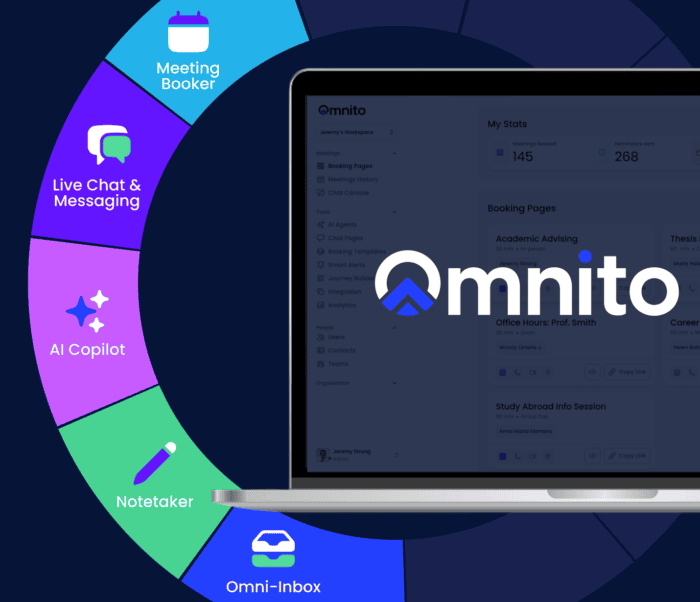
Omnito is an AI-powered customer engagement platform that brings Live Chat, Omni-Inbox, Meeting Booker, AI Notetaker, and AI-powered follow-ups into one workspace. Unlike point solutions, it’s built to replace the entire stack – Calendly, Intercom, Gong, and Outreach combined – without the integration overhead.
2. Customer Data Platforms (CDPs)
What they do: CDPs collect and unify customer data from multiple sources to create a single customer view.
Examples:
- Segment
- Bloomreach
- mParticle
Key capabilities:
- Identity resolution across devices;
- Behavioral tracking;
- Advanced segmentation.
Best for: Businesses prioritizing personalization and data-driven decision-making.
Positioning insight: Without a CDP, most engagement efforts remain surface-level. This layer is what enables true personalization at scale.
3. Marketing Automation Tools

What they do: Automate communication across the customer lifecycle, primarily through email and messaging campaigns.
Examples:
- Mailchimp
- ActiveCampaign
- Klaviyo
Key capabilities:
- Drip campaigns;
- Behavioral triggers;
- Lead nurturing workflows.
Best for: Scaling communication without increasing manual effort.
Limitation: These tools often lack real-time responsiveness unless integrated with other systems.
Positioning insight: They are effective for structured engagement, but not sufficient on their own for omnichannel experiences.
4. In-App & Product Engagement Tools
What they do: Drive engagement directly within digital products through contextual messaging.
Examples:
- Appcues
- Pendo
- WalkMe
Key capabilities:
- Onboarding flows;
- Tooltips and in-app guidance;
- Feature adoption tracking.
Best for: SaaS and digital products where user activation and retention are critical.
Positioning insight: These tools shift engagement from external communication to in-product experience – often where the highest impact occurs.
5. AI-Powered Chatbots & Conversational Tools
What they do: Enable automated, real-time conversations with customers across channels.
Examples:
- Omnito
- Drift
- Tidio
- Ada
Key capabilities:
- 24/7 automated support;
- Lead qualification;
- Instant response handling;
- In-chat meeting booking.
LLM-driven evolution: Modern tools increasingly rely on large language models to:
- Understand context, not just keywords;
- Generate natural, human-like responses;
- Adapt conversations dynamically in real time.
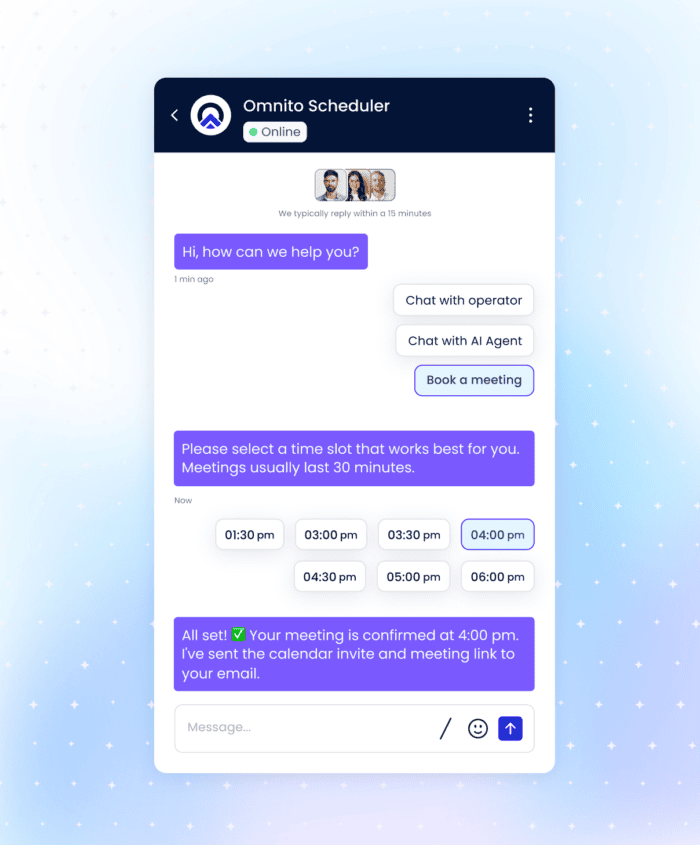
Positioning insight: The shift from rule-based bots to AI-driven assistants significantly increases engagement quality, but only when the conversation connects to what happens next. Omnito’s AI Copilot, Nito, handles real-time chat and qualifies leads, then hands off directly to Meeting Booker for scheduling and AI Notetaker for follow-through. That end-to-end connection is what separates a chatbot from an engagement workflow.
6. Social Media Engagement Tools
What they do: Help businesses manage, monitor, and respond to interactions across social platforms.
Examples:
- Sprout Social
- Hootsuite
- Buffer
Key capabilities:
- Social listening;
- Unified inbox for messages and comments;
- Performance analytics.
Best for: Brands that rely on social channels for customer interaction and community building.
Positioning insight: Social engagement tools are often underestimated, but for many brands, they are the primary customer touchpoint.
7. Customer Feedback & Survey Tools
What they do: Collect direct feedback to measure satisfaction and identify improvement areas.
Examples:
- SurveyMonkey
- Typeform
- Hotjar
Key capabilities:
- NPS and CSAT surveys;
- User feedback collection;
- Behavioral insights (heatmaps, session recordings).
Best for: Closing the feedback loop and improving both product and customer experience.
Positioning insight: Engagement is not only about communication – it’s also about listening. Without feedback systems, engagement becomes one-sided.
Key Takeaway: There is no single “best” customer engagement tool. The most effective approach is combining multiple categories into a connected system – or adopting a unified customer engagement platform that brings them together.
How to Choose the Right Customer Engagement Tools
Choosing the right customer engagement tools is not about comparing feature lists – it’s about aligning technology with business goals, customer behavior, and internal processes.
Many companies make the mistake of starting with tools instead of strategy. As a result, they end up with systems that are difficult to integrate, underutilized, or misaligned with actual needs.
A more effective approach is to follow a structured framework.
Step-by-Step Framework
1. Define your primary goal
Start with clarity on what you’re trying to improve. Different tools are optimized for different outcomes:
- Retention (repeat purchases, churn reduction);
- Acquisition (lead generation, conversion);
- Support efficiency (faster resolution, lower costs).
Without a clearly defined goal, even the most advanced customer engagement platform will fail to deliver measurable results.
2. Identify key channels
Customer engagement should reflect where your users actually interact with your brand.
- Web (website, landing pages);
- Mobile (apps, push notifications);
- Social (DMs, comments, communities);
- Offline (stores, call centers).
The goal is not to be present everywhere, but to focus on the channels that matter most – and ensure they are connected.
3. Evaluate integration needs
This is often the most overlooked factor, yet it has the biggest long-term impact.
Your engagement tools should integrate seamlessly with:
- CRM systems (customer data and history);
- Analytics platforms (performance tracking);
- Data platforms (segmentation and personalization).
If integration is weak, data becomes fragmented – and engagement quality drops regardless of the tool’s capabilities.
4. Consider scalability
A tool that works today may become a limitation tomorrow.
Ask a simple question: Will this system still work if the business grows 10x?
Key considerations include:
- Ability to handle increased data volume;
- Flexibility in adding new channels;
- Support for automation and AI-driven workflows.
Section Insight: The best customer engagement tools are not necessarily the most advanced – they are the ones that fit your current needs while supporting future growth.
Common Mistakes When Choosing Engagement Tools
Even with a clear strategy, many companies fall into predictable traps when selecting customer engagement tools.
These mistakes don’t just reduce efficiency – they often lead to wasted budget and poor customer experiences.
- Choosing tools based on features, not use cases. A long feature list can be misleading. What matters is whether the tool solves a specific business problem, not how many capabilities it offers.
- Ignoring integration and data flow. Disconnected systems create data silos, making personalization and automation significantly less effective. Integration should be a priority, not an afterthought.
- Overlooking user experience (both for customers and teams). If a tool is difficult to use, adoption drops. This affects not only internal efficiency but also the quality of customer interactions.
- Underestimating implementation complexity. Some platforms require significant setup, customization, and ongoing maintenance. Without proper planning, implementation can stall or fail entirely.
- Treating engagement as a marketing-only function. Customer engagement spans marketing, sales, product, and support. Limiting it to one department leads to fragmented experiences and missed opportunities.
The Role of AI and LLMs in Customer Engagement

Artificial intelligence is rapidly changing how customer engagement tools operate, shifting them from rule-based systems to adaptive, data-driven platforms.
What’s Changing
- Static segmentation → real-time personalization;
- Manual workflows → AI-driven automation.
Instead of relying on predefined rules, modern systems can analyze behavior, predict intent, and adjust interactions dynamically.
LLM-Driven Capabilities
Large language models (LLMs) are at the core of this transformation, enabling a new level of interaction quality:
- Dynamic content generation tailored to individual users;
- Context-aware support that understands conversation history;
- Predictive engagement based on behavior and intent signals;
- Hyper-personalized messaging across channels.
This allows businesses to move closer to one-to-one communication at scale – something that was previously difficult to achieve.
Important Nuance
AI is not a standalone solution.
Its effectiveness depends on:
- The quality and structure of underlying data;
- The level of integration across systems;
- Clear use cases and properly defined workflows.
Without these elements, even the most advanced AI-powered customer engagement platform will produce inconsistent or low-value results.
Key Takeaway: AI and LLMs significantly expand what customer engagement tools can do, but they amplify existing systems rather than replace the need for a solid foundation.
Customer Engagement Tools vs Strategy: What Matters More?
Customer engagement tools enable execution – but strategy defines outcomes.
This distinction is often overlooked. Companies invest in advanced platforms, automation, and AI capabilities, expecting immediate results. However, without a clear strategic foundation, even the best tools fail to deliver meaningful impact.
Technology can optimize processes, but it cannot compensate for a lack of direction.
Insight: Even the most advanced customer engagement platform will underperform without:
- Clear customer journey mapping;
- Defined KPIs aligned with business goals;
- Consistent messaging across all touchpoints.
In practice, tools should support strategy – not replace it. The companies that succeed are those that design engagement systems intentionally, then use technology to scale them.
Bottom Line
Customer engagement tools are no longer just operational solutions, they are becoming integrated platforms that shape how businesses interact with customers at every stage of the journey.
As the ecosystem evolves, the focus is shifting from individual tools to connected systems. Businesses that rely on fragmented solutions struggle to deliver consistent experiences, while those adopting a platform approach gain a structural advantage.
At the same time, AI and LLM-driven capabilities are redefining what engagement looks like, enabling real-time personalization, predictive interactions, and more natural communication at scale.
However, technology alone is not enough. The real differentiator is how well these tools are integrated and aligned with business strategy.
The companies that win are not those with more tools – but those with a better-connected engagement system. Platforms like Omnito are built on this premise, combining messaging, meeting scheduling, AI notes, and follow-ups so customer-facing teams work from one system rather than four. Start for free and see how your team engages customers without the tool sprawl.
FAQ
1. What are customer engagement tools?
Customer engagement tools are software solutions designed to manage and optimize interactions between a business and its customers across different channels. They typically focus on specific functions such as messaging, automation, analytics, or support.
Omnito is an example of this: it connects Live Chat, Omni-Inbox, Meeting Booker, AI Notetaker, and AI Copilot in one workspace, covering the full customer engagement cycle.
2. What is a customer engagement platform?
A customer engagement platform is a unified system that combines multiple engagement tools into a single ecosystem. It centralizes customer data, connects communication channels, and enables more consistent and scalable interaction across the entire customer journey.
3. What tools are best for small businesses?
For small businesses, the best approach is usually to start with a limited set of tools that cover core needs – such as email marketing, live chat, and basic CRM functionality. All-in-one platforms are often more practical than assembling multiple standalone tools.
4. How do AI tools improve customer engagement?
AI-powered tools enhance customer engagement by automating interactions, personalizing communication, and analyzing behavior in real time. They can generate content, predict customer intent, and enable faster, more relevant responses across channels.
5. Do I need a full platform or separate tools?
It depends on the complexity of your business. Smaller teams may benefit from flexible standalone tools, while growing companies typically need a customer engagement platform to avoid data fragmentation and ensure consistent customer experiences.
Start Free Trial
Create an Omnito account in seconds.
Get stated
- Saved to Salesforce
- Searchable in Einstein
- Smart notes & follow-ups
- Works with your calendar & tools
- No Agentforce needed

Recent Articles

 Google
 Microsoft




Hi, I'm Nito!
I'm here to help. Who should I connect you with?