



Retail customer engagement is no longer just about interactions – it directly impacts revenue through retention, repeat purchases, and customer lifetime value.
At the same time, expectations have shifted. Customers now expect personalization, speed, and seamless experiences across channels.
Yet many retailers still operate with fragmented systems and disconnected touchpoints.
So, how to improve customer engagement in retail in a way that actually drives measurable results?
Below are 7 strategies that consistently work across modern retail.
Key Takeaways
- Customer engagement directly influences revenue through retention and repeat purchases;
- Omnichannel is not about presence, but about connected customer experiences;
- Personalization and data are critical to scaling engagement effectively;
- Post-purchase engagement is often the most underutilized growth lever;
- The conversations happening in your chats, calls, and inboxes are a data source most retailers ignore;
- Sustainable engagement requires a system, not isolated tactics.
What Is Retail Customer Engagement (and Why It Matters)
Retail customer engagement refers to all interactions between a brand and its customers across the entire journey – from discovery to post-purchase communication.
It’s important to separate engagement from customer service:
| Aspect | Customer Engagement | Customer Service |
| Nature | Proactive | Reactive |
| Focus | Building relationships | Solving problems |
| Goal | Long-term loyalty | Issue resolution |
Strong engagement impacts key business metrics:
- Retention rate;
- Repeat purchases;
- Customer lifetime value (LTV).
In practical terms, engagement is not about activity – it’s about creating consistent, meaningful interactions that drive long-term revenue.
7 Proven Strategies to Improve Retail Customer Engagement

1. Build a True Omnichannel Experience
A common mistake is treating omnichannel as simply being present on multiple platforms. In reality, it’s about how well those channels are connected.
Customers expect seamless transitions between touchpoints. A typical journey might look like:
- Discovering a product on social media;
- Asking questions via chat;
- Completing the purchase online or in-store.
If these steps are disconnected, engagement drops.
So, what is omnichannel retail engagement in practice?
It’s a unified system where customer data, messaging, and context are synchronized across all channels:
- Website;
- Mobile apps;
- Social media;
- Physical stores.
Key elements of a strong omnichannel setup:
- Unified customer data across platforms;
- Consistent messaging and branding;
- Real-time synchronization of interactions;
- Ability to continue the journey across channels without friction.
The key insight is that omnichannel is not just a marketing tactic – it’s an operational model. Retailers that implement it effectively tend to see:
- Higher conversion rates;
- Improved customer retention;
- More consistent and predictable engagement outcomes.
2. Personalize Every Customer Interaction
Personalization in retail goes far beyond inserting a customer’s name into an email. What actually drives engagement is relevance – how well the experience reflects a customer’s behavior, preferences, and intent.
Modern customers expect brands to “remember” them. This includes:
- Browsing history;
- Previous purchases;
- Product preferences;
- Real-time intent signals.
So, how to personalize retail customer experience effectively?
It starts with segmentation. Instead of treating all customers the same way, retailers group users based on behavior and value. On top of that, recommendation engines use this data to suggest relevant products, increasing both engagement and conversion.
Done right, personalization doesn’t just improve experience – it directly impacts loyalty and repeat purchases.
3. Use AI and Automation to Scale Engagement
AI is often misunderstood as just another automation layer. In reality, its main value is in scaling personalization across thousands (or millions) of customers simultaneously.
So, what drives customer engagement in retail at scale?
AI plays a role in several key areas:
- Product recommendations based on real-time behavior;
- Chatbots that handle inquiries instantly;
- Automated support that reduces friction in the buying process.
The key shift is this: AI is not just about efficiency – it’s about relevance at scale.
Without AI, personalization remains manual and limited. With it, retailers can deliver tailored experiences consistently, regardless of customer volume.
But AI only delivers on that promise if the communication layer can keep up.
Live Chat & Unified Inbox: How They Support Customer Engagement
While omnichannel strategy defines how channels should work together, execution often breaks down at the communication layer.
This is where tools like AI-powered live chat and unified inbox systems become critical.
| Aspect | Live Chat | Unified Inbox |
| Primary role | Real-time customer interaction | Centralized conversation management |
| Core function | Engage, respond, convert in the moment | Organize, track, and coordinate conversations |
| Key capabilities | AI-first conversations; human handoff; in-chat scheduling; authenticated chat | All channels in one view; shared ownership; persistent context; follow-ups |
| Engagement flow | AI → human → scheduling within one conversation | Continuous conversation across channels and touchpoints |
| Main benefit | Reduces friction and increases conversion | Eliminates fragmentation and improves team coordination |
| Typical limitation | Often operates as a standalone channel | Requires proper setup and integration to deliver full value |
Omnito Live Chat is built around this exact flow. Customers start with AI trained on your business, get answers instantly, and only reach a human when the conversation genuinely requires it – with full context preserved at every handoff. When a meeting makes sense, scheduling appears directly inside the chat. No redirects, no separate booking links.
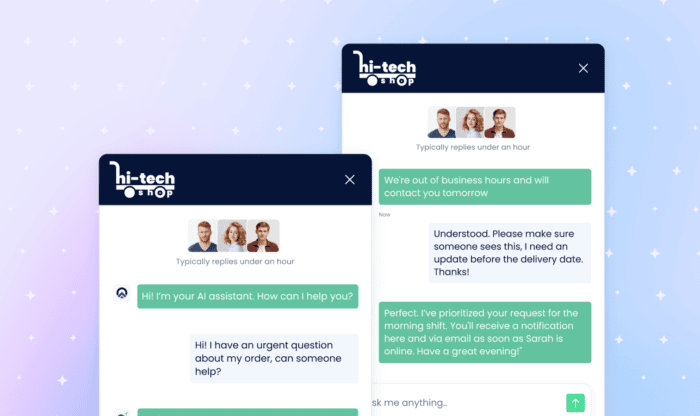
Omnito Live Chat
Omnito Omni-Inbox takes this further by bringing every conversation – chat, email, SMS, AI interactions – into a single shared workspace. Teams see who owns what, what’s in progress, and what needs follow-up without switching between tools. AI handles first responses and qualifies intent, so the inbox stays manageable even at high volume. The goal is effectively inbox zero: nothing missed, nothing stuck, every conversation moving toward an outcome.
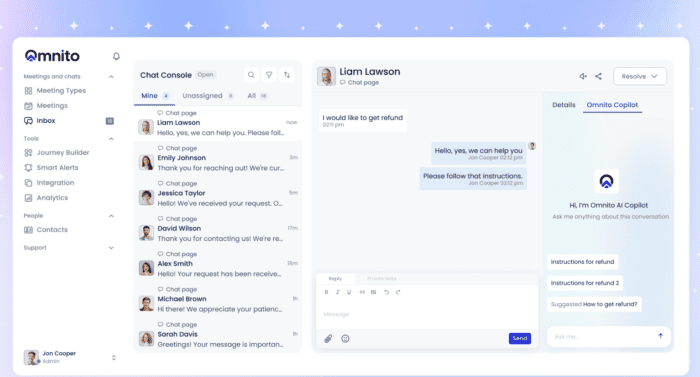
Together, these two tools turn engagement from a reactive process into a connected one, which is exactly what a retail customer engagement platform is designed to do.
4. Optimize the Entire Customer Journey (Not Just Sales)
One of the most common gaps in retail engagement strategies is focusing too heavily on the point of purchase.
In reality, engagement spans the full customer journey:
- Awareness – when customers first discover the brand;
- Consideration – when they compare options;
- Purchase – the transaction itself;
- Post-purchase – everything that happens after.
Most retailers invest heavily in acquisition and conversion, but lose momentum afterward. This is where engagement drops – and where long-term value is often lost.
A more effective approach is to design the journey as a continuous experience, where each stage builds on the previous one and keeps the customer connected to the brand.
5. Engage Customers After the Purchase
The post-purchase phase is one of the most underestimated drivers of engagement – and revenue.
So, how to increase repeat purchases in retail?
It often comes down to what happens after the sale. Effective post-purchase engagement includes:
- Follow-up communication (order updates, helpful content);
- Onboarding (especially for complex products);
- Review requests and feedback loops;
- Personalized offers based on the purchase.
This stage is critical because the customer is already “warm.” They’ve made a decision, and their level of trust is at its highest point.
Brands that actively engage customers after purchase tend to see stronger retention, higher lifetime value, and more repeat transactions.
6. Combine Physical and Digital (Phygital Experience)
Retail is no longer split between online and offline – it’s increasingly a hybrid experience.
Customers might browse online, visit a store, and then complete a purchase on mobile. The role of retailers is to connect these touchpoints into a single experience.
This is where “phygital” comes in – blending physical and digital interactions. Examples include:
- QR codes in-store that link to product details or reviews;
- Mobile apps that enhance the in-store experience;
- Real-time inventory visibility across channels.
Behind the scenes, this requires synchronized data and retail technology that connects systems in real time.
The goal is simple: remove friction and make every interaction feel consistent, regardless of where it happens.
7. Turn Customers Into Advocates (UGC, Loyalty, Community)
The highest level of engagement is when customers don’t just buy – but actively promote your brand.
This is where engagement evolves into advocacy.
Key drivers here include:
- User-generated content (reviews, social posts);
- Referral programs;
- Loyalty programs that reward repeat behavior.
When done right, this creates a growth loop:
Engagement → Loyalty → Advocacy → New customers → More engagement.
Instead of constantly acquiring new users from scratch, brands leverage their existing customer base as a growth engine.
This approach is not only more cost-effective – it’s also more sustainable in the long term.
Common Mistakes Retailers Make
Even when retailers invest in engagement, results often fall short – not because of lack of effort, but because of structural issues.
One of the most common problems is fragmented channels. Brands operate across multiple platforms, but without proper integration. As a result, customer interactions feel disconnected rather than continuous.
Another major gap is the lack of real personalization. Many retailers still rely on generic messaging, missing the opportunity to use behavioral data and intent signals to create relevant experiences.
There’s also an overemphasis on acquisition. A significant portion of budget and attention goes into bringing in new customers, while existing ones receive minimal engagement after the first purchase.
Conversations also fall through the cracks. Customer questions come in across chat, email, and social, but without a unified system to manage them, responses are slow, context gets lost, and follow-ups don’t happen. The interaction ends, but the relationship doesn’t move forward.
Finally, post-purchase engagement is often ignored altogether. Once the transaction is completed, communication drops – despite this being one of the most valuable stages for building loyalty and driving repeat purchases.
Where Retailers Go Wrong (and What to Do Instead)
| Mistake | What It Leads To | What to Do Instead |
| Fragmented channels | Inconsistent experience, drop-offs between touchpoints | Integrate systems and unify customer data across channels |
| No real personalization | Low relevance, weak engagement | Use behavioral data, segmentation, and recommendations |
| Focus only on acquisition | High CAC, low LTV | Balance acquisition with retention strategies |
| Unmanaged conversations | Slow responses, lost context, missed follow-ups | Centralise conversations in one shared inbox |
| Ignoring post-purchase | Lost repeat revenue | Build structured post-purchase flows (follow-ups, offers) |
How to Measure Customer Engagement
Measuring engagement requires looking beyond surface-level interactions and focusing on metrics tied to business outcomes.
Some of the most relevant indicators include:
- Net Promoter Score (NPS), which reflects customer satisfaction and likelihood to recommend;
- Retention and churn rates, showing how well customers stay over time;
- Repeat purchase rate, a direct signal of ongoing engagement;
- Behavioral engagement metrics, such as session frequency, interaction depth, and response rates.
However, the key is not just tracking these metrics, but structuring them into a clear measurement model.
Simple Engagement Measurement Framework
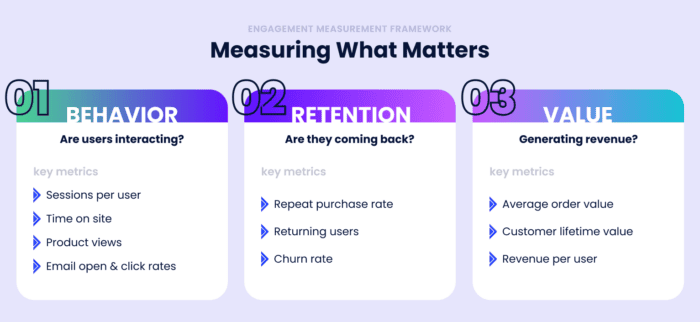
At a practical level, customer engagement can be evaluated through a combination of three layers:
1. Behavior (Are users interacting?)
Metrics: sessions per user, time on site, product views, email open/click rates
2. Retention (Are they coming back?)
Metrics: repeat purchase rate, returning users, churn rate
3. Value (Are they generating revenue?)
Metrics: average order value (AOV), customer lifetime value (LTV), revenue per user
[make an image of the text above (1. Behavior …), the text can be shortened a bit (use AI), but keep the point and the metrics; metric names should be used without abbreviations]
Here is what I made with Claude. It’s not bad, but can be polished to better align with brand colors.
You can think of engagement as a combined effect:
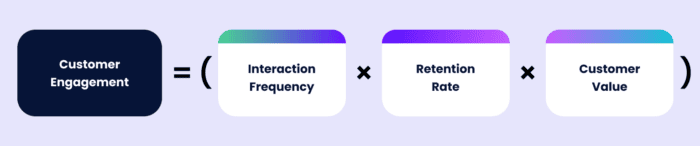
This is not a strict mathematical formula, but a useful way to align teams:
- If users interact but don’t return → engagement is weak
- If they return but don’t spend → engagement is shallow
- Only when all three grow → engagement drives revenue
This approach helps shift the focus from isolated metrics to a system that directly reflects business impact.
Bottom Line
Retail customer engagement is not a set of isolated tactics – it’s a system.
The retailers that consistently outperform are those that:
- Unify customer data across channels;
- Take a long-term view on relationships, not just transactions;
- Focus on building end-to-end customer experiences rather than one-off campaigns.
In practice, this means aligning technology, data, and strategy around one goal: creating meaningful, continuous interactions that drive sustainable growth. Omnito is built for exactly that: bringing live chat, unified inbox, meeting booking, and AI into one connected platform so every customer interaction has context, ownership, and a clear next step. If you’re building that kind of system, it’s a good place to start — and you can do that for free.
FAQ
1. How do you measure customer engagement in retail?
Customer engagement is best measured through a combination of behavioral and business metrics, such as repeat purchase rate, retention, customer lifetime value (LTV), and interaction frequency. The most important aspect is linking engagement metrics directly to revenue outcomes rather than tracking them separately.
2. What is the difference between customer engagement and customer experience?
Customer experience is the overall perception a customer has of a brand, while engagement refers to the ongoing interactions across different touchpoints. Engagement actively shapes the experience and plays a key role in building long-term relationships.
3. How do you build a retail customer engagement strategy from scratch?
Start by mapping the full customer journey – from awareness to post-purchase – and identifying gaps in interaction. Then align channels, unify customer data, and prioritize high-impact areas like personalization and post-purchase engagement before scaling with automation and AI. Platforms like Omnito can support this by connecting live chat, inbox management, and meeting booking in one place, so you’re not stitching together separate tools as you scale.
4. Why is post-purchase engagement so important in retail?
Post-purchase is the stage where trust is highest, making it the most effective moment to build loyalty. Brands that actively engage customers after a purchase – through follow-ups, support, and personalized offers – typically see higher retention and repeat purchase rates.
5. Can small retailers compete with large brands in customer engagement?
Yes, because effective engagement is not only about budget, but about relevance and consistency. Smaller retailers can achieve strong results by focusing on personalization, direct communication, and a limited number of well-integrated channels.
Start Free Trial
Create an Omnito account in seconds.
Get stated
- Saved to Salesforce
- Searchable in Einstein
- Smart notes & follow-ups
- Works with your calendar & tools
- No Agentforce needed

Recent Articles
 Google
 Microsoft




Hi, I'm Nito!
I'm here to help. Who should I connect you with?